Platform
How Venevor proves it.
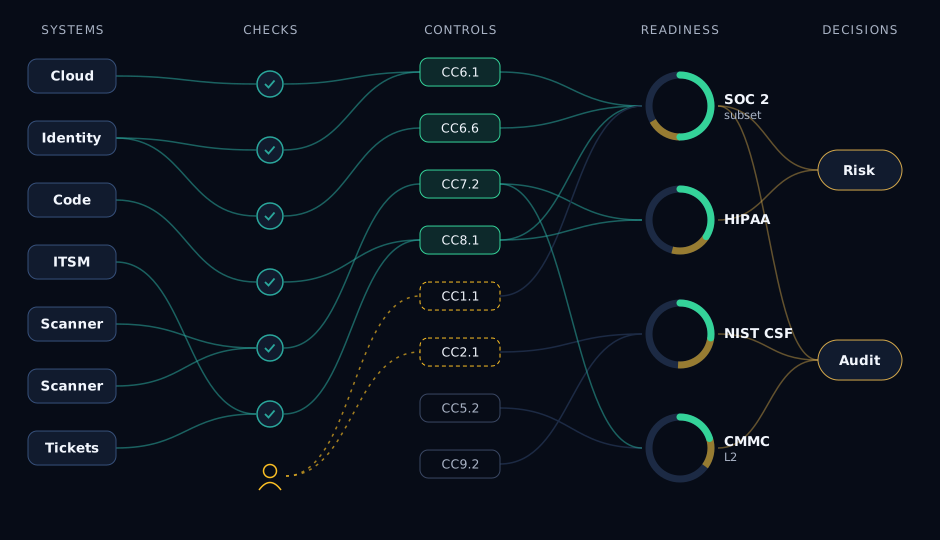
Four steps take a signal from one of your systems to a decision you can defend: connect, check, prove, decide. At every step Venevor keeps what was verified apart from what was only asserted.
1Connect
Read the systems you already run.
Venevor connects to cloud, identity, code, scanning and service tools with read access, and shows every connection's health in one place — when it last synced, whether it worked, and how fresh its data is.
What it does
Each connection reports its own state: healthy, stale, partial, failed, or authorization lost.
What it never does
Call a connection healthy because it once worked. A sync that stopped shows as stopped.
Illustrative example — synthetic data
2Check
Every reading, timestamped and kept.
Automated checks read each system on a schedule and record the result — pass, fail or error — with the time and the source. Results are never edited after the fact.
What it does
Keeps a history you can open: what was checked, when, and what came back.
What it never does
Treat an unreadable check as a pass. An error is recorded as an error.
Illustrative example — synthetic data
3Prove
Controls that prove themselves.
An automated control's status comes only from its latest check — nobody can set it by hand. Controls a person attests are kept, and marked as asserted.
What it does
Shows each control as verified, not verified, or manual — current as of its latest check, with the reason beside it.
What it never does
Let a person flip an automated control to compliant.
Illustrative example — synthetic data
4Decide
From proof to the next decision.
Readiness rolls the controls up per framework. Risk and exposure show what the gaps put at stake. The auditor workspace shows each claim with its evidence. Each view tells you what to do first.
What it does
Separates verified from asserted in every total. They are never added together.
What it never does
Show unknown as fine. If nothing can check a requirement, it says so.
Illustrative example — synthetic data
Five states, never blurred
A control is not just compliant or not.
Verified
A system was read and the result proves the control as of the latest check, with a timestamp and a source you can open.
Asserted
A person says it holds. Venevor records who and when, and never counts it as verified.
Exception
A known gap someone accepted, with an owner and an expiry date, so it can't quietly become permanent.
Gap
The evidence shows the control not holding. It goes to the top of the list, not the bottom of a report.
Unknown
No source can check it yet, or the evidence went stale. Shown as unknown, never as fine.
Integrations
Connects to what you run.
Connections to your cloud, identity, endpoint, code, scanning and service-desk tools, so evidence comes from the systems themselves.
Cloud
- AWS
- AWS Security Hub
Identity
- Okta
- Microsoft Entra ID
Endpoint & devices
- Microsoft Defender
- CrowdStrike
- Microsoft Intune
Code
- GitHub
Vulnerability scanning
- Tenable
- Qualys
Service desk & CMDB
- ServiceNow
- Jira
Running something else? Tell us your stack.
See all integrationsProduct names are trademarks of their owners. Listed by name only — no endorsement or partnership is implied.
What's in the platform
Compliance
Compliance automation
Controls that prove themselves from live checks.
Learn more →Evidence
Every check result, timestamped and kept.
Learn more →Audits & auditor workspace
Live evidence packages and a dedicated auditor view.
Learn more →Policy management
Policies approved, signed, acknowledged and exported.
Learn more →Exceptions
Accepted gaps with an owner and an expiry date.
Learn more →
Risk
Enterprise risk
A risk register scored, treated and tied to controls.
Learn more →Financial risk quantification
FAIR-aligned loss modeling with Monte Carlo runs.
Learn more →Exposure score
One 0–1,000 exposure score, with its method shown.
Learn more →Vulnerability management
Scanner findings ranked by exploitation, fix-first.
Learn more →
Operations
Asset inventory
One reconciled inventory from many sources.
Learn more →Third-party risk
Vendor questionnaires, portal and approval routing.
Learn more →Incident management
Incidents tracked by phase, with breach notification.
Learn more →Projects & delivery risk
Delivery risk signals tied to controls and vendors.
Learn more →
See it work on evidence like yours.
A walkthrough built around your frameworks and the systems you already run.